

Journal→Why the Entryway Is the Most Honest Room in the House
Why the Entryway Is the Most Honest Room in the House
By Savannah Dodge · May 20, 2026 · 9 min read
You come home at the end of a long day and the entryway tells the whole story before you've taken your coat off. The bag dropped just inside the door. The mail that made it as far as the console and no further. The shoes that got as far as inside and stopped there. The dog leash draped over the thing it's always draped over because there was never a better option. Not because you're careless or disorganized. Because the space didn't make it easy to be anything else.
The entryway is the room that lives in the gap between how we want to live and how we actually do. And that gap is not a character flaw. It is a design problem -- one that is almost universally undertreated, underbudgeted, and underestimated in residential design. Every other room in a home gets considered. The entryway gets whatever is left.
This post is an argument for giving it more.
The Entryway Sets the Emotional Temperature of the Whole House
The transition from outside to inside is one of the most psychologically loaded moments in daily life, and we move through it so automatically that we've stopped registering how much it affects us.
Coming home should feel like a decompression. A physical and emotional exhale. The moment the outside world releases its grip and something quieter takes over. When the first thing you encounter is disorder -- surfaces you can't put anything down on, no clear place for the things in your hands, visual noise that your nervous system has to work to process -- that transition doesn't happen. You carry the outside in with you. The stress of the commute, the unfinished business of the day, the low-grade tension of not knowing where anything goes. It follows you through the door and into the rest of the evening.
When the entryway is designed well, it performs a reset. Not a dramatic one -- nothing so grand as a spa or a sanctuary. Just a space that receives you, absorbs what you're carrying, and signals clearly that you have arrived somewhere worth returning to. That is not a luxury. It is one of the highest-impact design investments you can make in a home, and it happens in the first fifteen feet.
Why It's the Most Honest Room in the House
Every other room in a home can be closed off, tidied before company arrives, presented at its best. The entryway cannot. It is in constant use, by everyone, every single day, under every emotional condition the household produces. It absorbs the full reality of how a family moves through the world -- the sports equipment and school bags, the dog gear and seasonal coats, the packages that arrived and haven't been opened, the things that are just passing through.
There is no version of the entryway that exists only for guests. It is too immediate, too functional, too embedded in the daily rhythm of the house to ever be purely aspirational. And that is precisely what makes it the most revealing room in any home. Walk into someone's entryway and you understand immediately how they actually live -- not how they'd like to, not how they'd present themselves if given time to prepare, but how they live at 6:30 on a Tuesday when everyone is tired and dinner needs to happen.
Designing the entryway well means designing for that Tuesday. For the reality of the household as it actually operates, not a curated version of it. That is harder than designing for an idealized life. It requires more specificity, more honesty about how people move and what they carry and what they need in the first ten seconds of being home. And it is more important than almost any other design problem in the house, precisely because it happens every single day.
The Four Things Every Entryway Needs to Do
When I'm working through an entry or mudroom with a client, I'm thinking about four distinct functions. A well-designed entryway does all of them simultaneously and makes none of them feel like work.
01 - It needs to receive you. This is the arrival experience -- the sightline you walk into, the scale of the space, the first thing your eye lands on. In the best entries, there is a moment of intention waiting for you. A piece of art, a considered light fixture, a view through to something beautiful deeper in the house. Something that says this space was thought about, that your arrival was anticipated. It doesn't need to be grand. It needs to be deliberate.
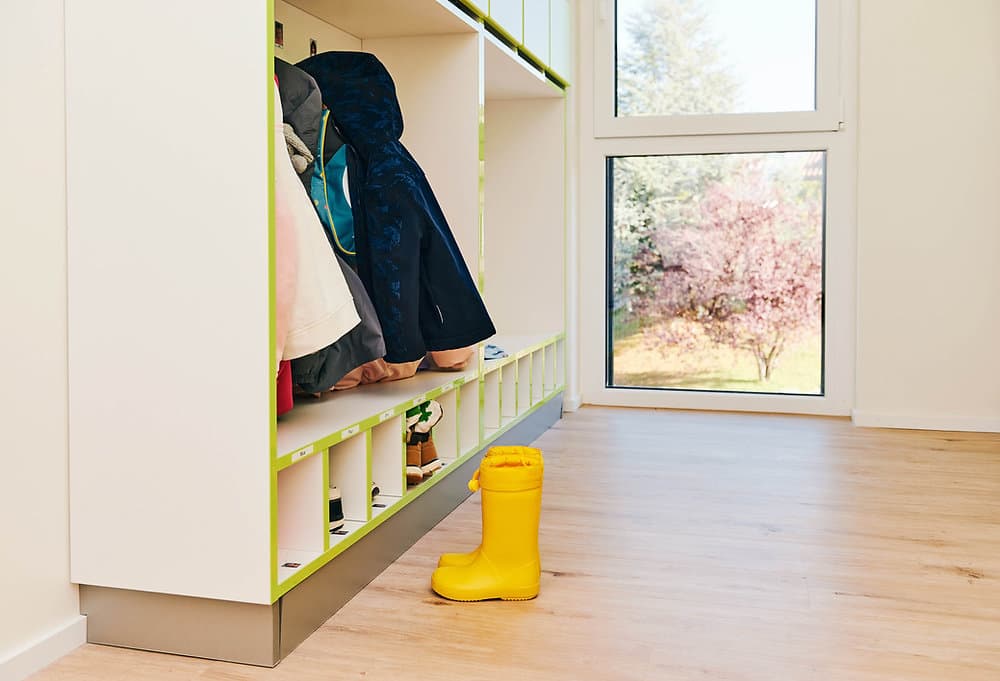
02 - It needs to contain the transition. Everything that comes in with you and needs to stop there requires a home. Hooks at the right height for every member of the household. A surface to set things down without creating a pile. Storage that is genuinely accessible, not beautiful boxes on a high shelf that no one ever opens. Dedicated space for shoes, bags, dog gear, seasonal layers. The infrastructure of daily life, built in from the beginning rather than improvised with whatever furniture fit.
03 - It needs to signal the rest of the house. The entryway is the first sentence of a longer story, and it should set up what follows rather than contradict it. The palette, the materiality, the scale -- all of it should be in conversation with the rooms beyond. An entry that reads as a completely different design register than the rest of the home creates a subtle but persistent dissonance. You feel it even when you can't name it.
04 - It needs to hold the threshold. This is the most abstract function and the most important one. The entryway is a boundary -- inside from outside, work from home, the world from your refuge. Good design makes that boundary legible and felt. It doesn't have to be dramatic. It can be as simple as a change in flooring material, a shift in ceiling height, a lighting transition that marks the passage from one register to another. What it cannot be is nothing. A threshold that doesn't register as a threshold isn't doing its job.
What Goes Wrong and Why
The most common failures in entryway design are predictable, and most of them stem from the same root cause: the space was treated as leftover rather than intentional.
The storage is either absent or aspirational. Beautiful hooks that aren't where anyone naturally reaches. A console with no drawers. Cubbies sized for a catalog shoot rather than an actual family's actual gear. When storage doesn't work with the way people move, people stop using it within a week and revert to the floor.
The lighting is purely functional. A single overhead fixture, probably a flush mount, probably chosen because it fit the ceiling height. The entryway is the first impression of the entire home and it is almost universally lit like a utility corridor. Layered lighting -- a pendant or sconce that creates atmosphere, something that makes the space feel warm rather than operational -- changes the entire emotional quality of coming home.
The scale is mismatched. A grand double-height foyer that leads into intimate, low-ceilinged rooms. Or more commonly in the homes I work with in the Hudson Valley, a cramped entry tucked into an old farmhouse that opens without transition into the main living space. Both create dissonance. The entry should modulate between the outside world and the interior world, not lurch between them.
There is no moment of arrival. Nothing to land the eye on, nothing that marks the space as considered, nothing that says you are home. This is the easiest failure to correct and the one with the most immediate emotional return.
On Designing for Real Life
Oakley is almost eleven years old and has, over the course of his life, accumulated what can only be described as a wardrobe. Rain jacket for wet days. Puffer for when it drops below freezing. Flannel for the in-between. Harness, leash, a backup leash, and the particular bandana he wears in winter because he has opinions about his appearance. There is also the matter of the post-walk towel, because he will not submit to having his paws wiped without a specific ritual that involves a specific texture.
All of this lives in our entryway. Not because we planned it that way from the beginning, but because that is where it needed to be. And the difference between an entryway that absorbs all of it gracefully and one that is defeated by it is almost entirely a function of how well the storage was designed.
This is true for every household I work with. The specific contents change -- kids' sports equipment, ski gear, gardening tools, a rotating cast of seasonal layers -- but the principle is identical. The entryway has to hold the full reality of how this particular family moves through the world. When it does, daily life gets measurably easier. When it doesn't, the chaos is not a personal failure. It is a design failure, and it has a design solution.
What the Entryway Can Become
When this space receives the same level of intention as every other room in the house -- a considered palette that opens the story of the interior, storage that is specific to how this household actually operates, lighting that creates atmosphere rather than just visibility, a moment of beauty that marks the arrival -- it stops being the room you rush through and becomes the room that changes the quality of coming home.
That sounds like a large claim for a small space. But the entryway is experienced more frequently than any other room in the house. Every person who lives there passes through it multiple times a day, every day, for as long as they live there. The cumulative effect of a space that receives you well, that absorbs the transition from outside to inside, that makes the first moments of being home feel easy rather than effortful -- that accumulates into something significant over time.
The bag will still get dropped sometimes. The mail will still find its way to the wrong surface. But when the space is designed to work with the reality of daily life rather than against it, the gap between how we want to live and how we actually do gets smaller. That is what good design does in every room. The entryway just makes it impossible to pretend otherwise.
If your entryway is the room you rush past rather than the one that welcomes you home, I'd love to help change that.
Love,
Sav
Let's Chat!

From the Studio
Savannah Dodge
Savannah Dodge is the Chief Executive Officer and Principal Designer of Curio Studio. She earned her BFA in Interior Design from the New England School of Art & Design at Suffolk University and brings over a decade of experience designing thoughtful, layered homes.
More about the studioMore from the journal
April 15, 2026
How Our Homes Shape Our Physical Health
We spend more time inside our homes than almost anywhere else. We sleep there, eat there, work there, recover there. And…
Read →
April 8, 2026
Dog-Friendly Interior Design: What to Consider in Every Space
Growing up, I often felt more connected to the animals in my life than to many of the people I met. I spent my childhood…
Read →
February 25, 2026
Reclaiming Our Ecological Relationship to the Sun
Before there were buildings, there was light. Our biology was shaped under open skies. Long before architecture, before…
Read →